
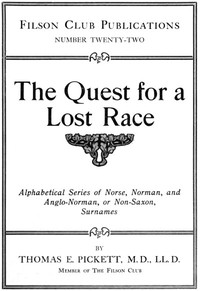
The Quest for a Lost Race by Thomas Edward Pickett
Published in 1909, Thomas Edward Pickett's The Quest for a Lost Race is a strange and absorbing artifact. It's not a novel, but the true story of Pickett's own decades-long investigation. He became convinced that a sophisticated, light-skinned race—the 'Mound Builders'—constructed the thousands of ancient earthworks found across the United States, only to vanish or be wiped out before the ancestors of modern Native Americans arrived.
The Story
The book follows Pickett's journey as an amateur archaeologist and historian. He starts with the physical evidence: examining burial mounds, analyzing skeletons that seemed (to him) to have 'Caucasian' features, and cataloging artifacts he believes are too advanced for the tribes known to history. He then combs through old explorers' journals, like those of Hernando de Soto, looking for mentions of fair-skinned people. Finally, he interprets Native American oral traditions, reading stories of conflict with earlier inhabitants as proof of his lost race. The narrative is the step-by-step building of his case, meeting resistance from mainstream scholars along the way.
Why You Should Read It
Here's the thing: modern anthropology has thoroughly debunked Pickett's core theory. We now understand the mounds as the incredible work of ancestral Native American cultures. So why read it? Because it's a gripping portrait of how ideas are born and fought for. Pickett's passion is palpable. You feel his excitement at each new 'discovery' and his frustration with critics. Reading it today, with our knowledge, creates a unique tension. You see the gaps in his logic and the biases of his era, but you also can't help but be swept up in his detective work. It's less about the answer and more about the human drive to solve a mystery.
Final Verdict
This book is perfect for readers who love historical rabbit holes and flawed, passionate narrators. It's not for anyone seeking factual, modern archaeology. Instead, think of it as a primary source from the history of ideas itself. If you enjoyed the obsessive quest in books like The Lost City of Z or are fascinated by how myths and theories take shape, you'll find Pickett's forgotten work strangely compelling. Just remember to keep your modern perspective handy—it's the essential companion for this particular quest.
Aiden Scott
1 year agoSimply put, it manages to explain difficult concepts in plain English. One of the best books I've read this year.
Mason Allen
3 months agoCitation worthy content.
Mary Perez
1 year agoHaving read this twice, it creates a vivid world that you simply do not want to leave. Worth every second.
Jackson Williams
5 months agoAfter hearing about this author multiple times, the pacing is just right, keeping you engaged. Definitely a 5-star read.





Barbara Hill
1 year agoWow.