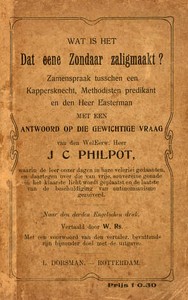
Wat is het dat eene zondaar zaligmaakt? by J. C. Philpot
First, a quick note: this book was written in Dutch in the 1800s by Joseph Charles Philpot, a minister in the Strict Baptist tradition. The title translates to 'What is it that saves a sinner?' That question is the entire plot.
The Story
There's no narrative with characters or a setting. The 'story' is the argument itself. Philpot acts like a guide, walking the reader through a process of elimination. He starts by looking at all the things people commonly think save them: being morally good, feeling sorry for their mistakes, having strong religious emotions, or simply agreeing with certain ideas about God. One by one, he explains why these, on their own, fall short. They can be imitated or faked, and they don't have the power to truly change a person's core relationship with God. The tension builds as he clears away these options. What's left? The book's climax is his answer: it is the direct, personal, and powerful application of Christ's finished work to the soul by the Holy Spirit. It's not about what we do, but about what is done to us and for us.
Why You Should Read It
I'll be honest, this isn't light reading. But its power is in its razor-sharp focus. In a world (and a religious landscape) full of self-help and 'do better' messages, Philpot's writing is a jarring corrective. It takes the spotlight completely off human effort and places it squarely on divine action. Reading it feels mentally rigorous and strangely liberating. It challenges easy assumptions and forces you to think deeply about the foundation of faith. Even if you don't agree with every theological point, the relentless pursuit of the central question is intellectually and spiritually stimulating. It's like a philosophical workout for your soul.
Final Verdict
This book is a specialized tool. It's perfect for readers interested in deep Christian theology, church history, or the writings of the Protestant Reformers and Puritans. It's for anyone tired of superficial religious talk and hungry for a serious, unflinching examination of a foundational doctrine. If you enjoy authors like John Bunyan or John Owen, you'll find a kindred spirit in Philpot. However, if you're looking for a story, practical life advice, or a broad introduction to Christianity, this probably isn't your starting point. Approach it as a challenging and rewarding deep dive into a single, eternal question.